Eturns Team · February 12, 2026 · Updated April 18, 2026 · 5 min read
How to Measure AI Support ROI for Your Shopify Store
TL;DR
Calculate AI support ROI with this formula: (monthly cost savings + monthly retained revenue - AI tool cost) / AI tool cost. A store handling 500 returns/month can expect 3-10x ROI, saving $5,000-$12,000 monthly in support costs alone.
AI Support ROI Ranges from 3x to 10x for Most Shopify Stores
The return on investment for AI customer support is measurable in hard dollars, not abstract "efficiency gains." For a typical Shopify store handling 500 after-sale requests per month, AI support delivers $5,000-$8,000 in monthly savings — representing a 3x to 10x return on the cost of the AI platform itself. The key is knowing which metrics to track and how to calculate the real financial impact.
This is not a feel-good metric. If you are considering AI customer support for your e-commerce store, the ROI equation is straightforward: add up what you save on support costs and what you retain in revenue that would have been lost, subtract what the AI tool costs, and divide by the tool cost. Most stores that implement AI support correctly see a positive ROI within the first 30 days.
The Five Metrics That Matter
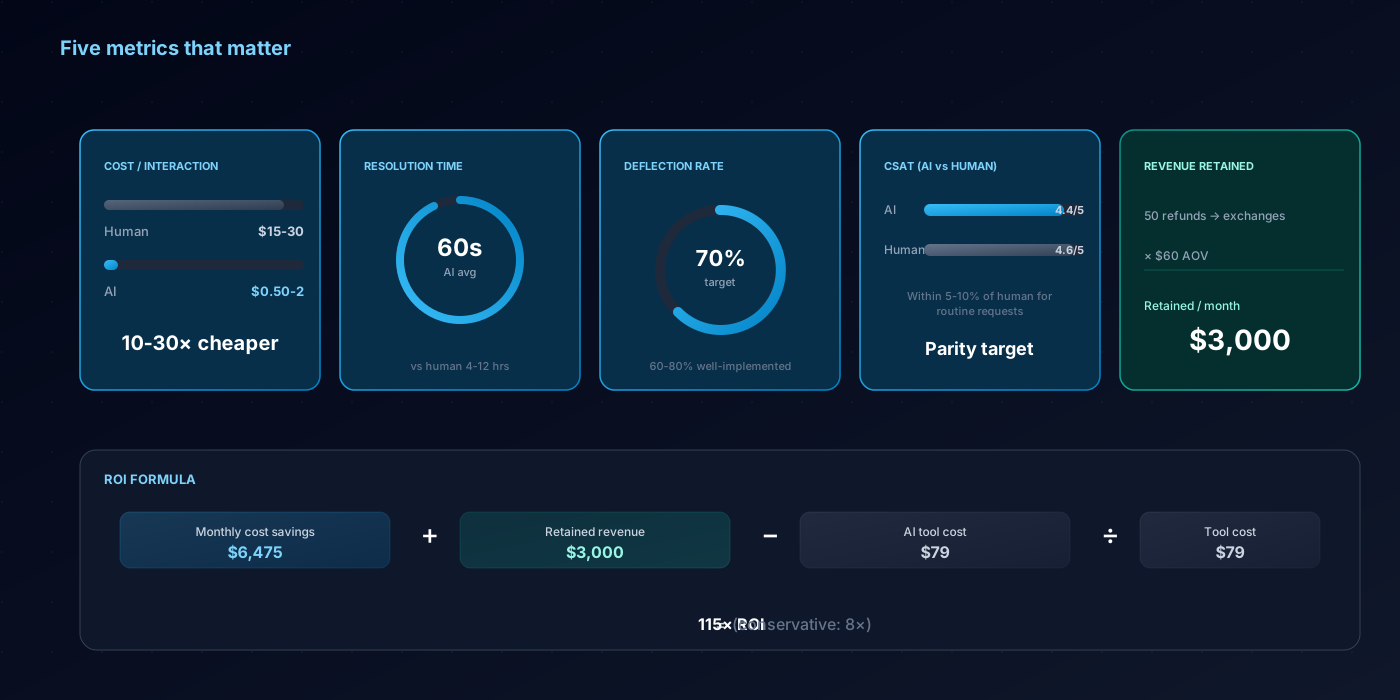
Not every customer support metric is relevant to AI ROI. These five tell the real story.
Cost Per Interaction
This is the most direct measure. Calculate your current cost per human-handled interaction by dividing total support costs (salaries, benefits, software, training, management) by total interactions. For most e-commerce teams, this lands between $15 and $30 per interaction (Forrester Research). AI interactions cost $0.50-$2 each. The gap between these numbers is your savings per deflected ticket.
Resolution Time
Human agents take an average of 4-12 hours to respond to an after-sale request, and resolution often requires 2-3 back-and-forth messages over 1-3 days. AI resolves routine requests in 30-60 seconds in a single conversation. Faster resolution correlates directly with customer satisfaction — Zendesk's data shows that customer satisfaction drops 15% for every 24 hours of delay in first response.
Deflection Rate
Deflection rate measures the percentage of incoming requests that AI resolves without human involvement. As we show in our walkthrough of how AI chatbots handle returns, well-implemented AI support systems achieve 60-80% deflection rates for after-sale requests. This is your multiplier — if 70% of 500 monthly requests are handled by AI, that is 350 interactions moved from the $20 column to the $1.50 column.
Customer Satisfaction (CSAT)
Track CSAT separately for AI-handled and human-handled interactions. Properly implemented AI support typically scores within 5-10% of human support on satisfaction surveys for routine requests, and often scores higher for simple inquiries because of the instant response time. If your AI CSAT drops significantly below your human CSAT, it signals a tuning problem, not an AI problem.
Revenue Retained Through Exchanges
This metric is often overlooked but can be the largest component of AI ROI. When AI instantly offers exchange options with real-time inventory checks, a portion of customers who would have requested a refund choose an exchange instead. If AI converts even 10-15% of return requests into exchanges, the revenue impact is substantial. On a $60 average order value, converting 50 returns to exchanges per month retains $3,000 in revenue.
The ROI Formula
The formula for AI support ROI is:
ROI = (Monthly Cost Savings + Monthly Retained Revenue - Monthly AI Tool Cost) / Monthly AI Tool Cost
Each component breaks down as follows:
Monthly Cost Savings = (Number of AI-Deflected Interactions) x (Human Cost Per Interaction - AI Cost Per Interaction)
Monthly Retained Revenue = (Number of Returns Converted to Exchanges) x (Average Order Value)
Monthly AI Tool Cost = Platform subscription + API/usage fees
Example Calculation: A Store Doing 500 Returns Per Month
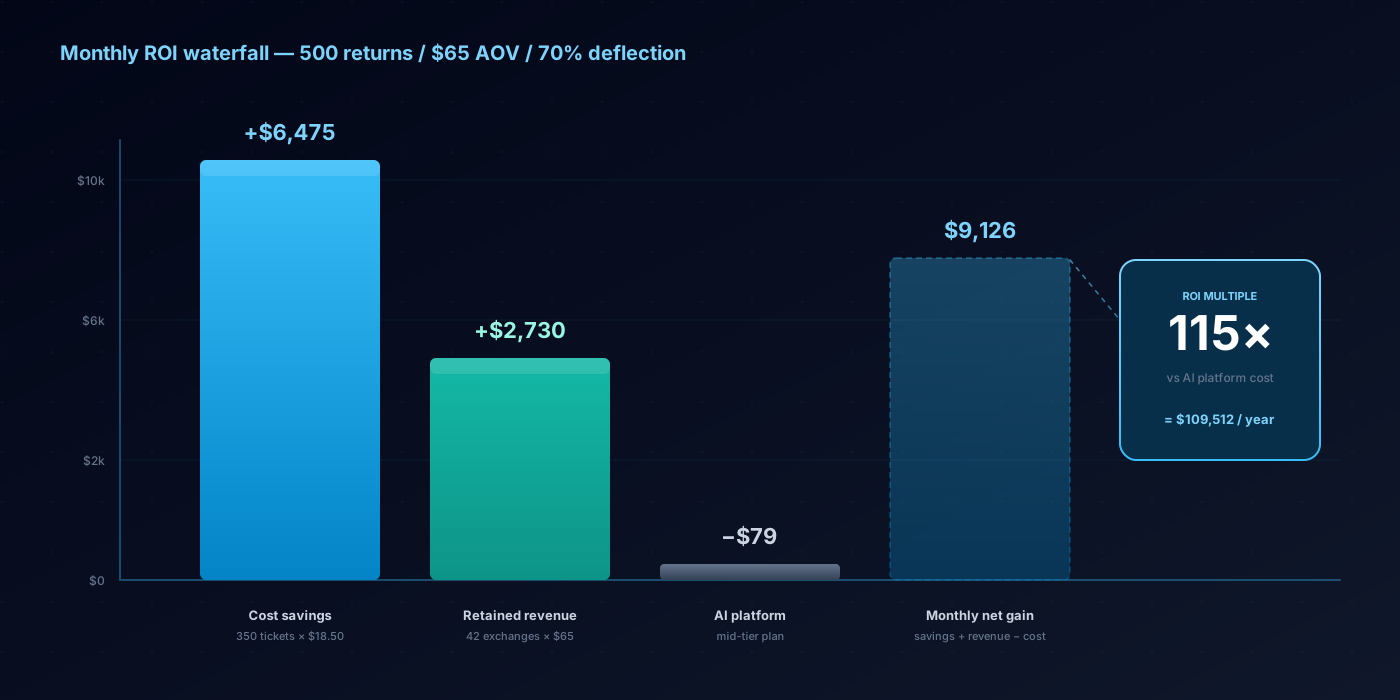
Let us walk through a realistic scenario for a mid-size Shopify store.
Current state: - 500 after-sale requests per month - Average human cost per interaction: $20 - Total monthly support cost for after-sale: $10,000 - Average order value: $65
With AI support: - AI deflection rate: 70% (350 requests handled by AI) - AI cost per interaction: $1.50 - Remaining human interactions: 150 at $20 each - AI platform cost: $79/month (mid-tier plan) - Return-to-exchange conversion: 12% of AI-handled returns (42 exchanges)
Monthly cost savings: 350 deflected interactions x ($20 - $1.50) = 350 x $18.50 = $6,475
Monthly retained revenue: 42 exchanges x $65 = $2,730
Monthly AI tool cost: $79 (platform) + $446 (350 interactions x $1.50 estimated API/usage minus platform inclusion) = approximately $525 total
For simplicity, let us use the platform cost of $79 since most mid-tier plans include a generous interaction allowance:
ROI = ($6,475 + $2,730 - $79) / $79 = $9,126 / $79 = 115x
Even with a more conservative estimate — using $500 total monthly cost for the AI tool, a 50% deflection rate, and no exchange conversion credit — the ROI still exceeds 8x:
Conservative ROI = ($4,625 + $0 - $500) / $500 = 8.25x
What Good AI Support ROI Looks Like
Based on industry benchmarks and published case studies from platforms like Gorgias, Tidio, and Intercom:
- 3-5x ROI is typical for stores in their first month, before optimization
- 5-10x ROI is standard for stores after 30-60 days of tuning
- 10x+ ROI is achievable for stores with high ticket volumes (1,000+ monthly) and well-documented policies
If your ROI is below 3x after 60 days, the issue is almost certainly in implementation — vague policies, shallow integration, or poor escalation design — not in the fundamental economics of AI support.
Tracking ROI Over Time
Set up a monthly dashboard with these numbers:
- Total after-sale requests received
- AI-resolved requests (no human involvement)
- Escalated requests (AI started, human finished)
- AI cost (platform fee + any usage-based charges)
- Human support cost (agent hours x loaded hourly rate)
- Exchanges processed by AI (with revenue value)
- CSAT scores (split by AI vs human resolution)
Review monthly. Your deflection rate should climb during the first 90 days as you refine policies and tune the AI. If it plateaus below 50%, audit your policy documentation — the AI can only enforce rules you have clearly defined.
Frequently Asked Questions
How do I calculate the "human cost per interaction" accurately?
Add up all support-related costs for one month: agent salaries, benefits (typically 25-30% of salary), support software subscriptions, training costs, and management/QA time allocated to support. Divide by the total number of interactions handled that month. Most stores underestimate this number because they forget benefits, training, and management overhead. The fully loaded cost is typically 40-60% higher than just the hourly wage.
Should I count cost avoidance (not hiring) as part of ROI?
Yes. If your store is growing and you would need to hire an additional support agent at $3,500/month to handle increased volume, but AI absorbs that growth instead, the avoided hire is a real cost savings. This is especially relevant for seasonal businesses that would otherwise need temporary staff for peak return periods.
What if my CSAT drops after implementing AI?
Investigate which specific interaction types are scoring lower. Usually, the issue is not that AI handles routine requests poorly — it is that the escalation experience is clunky. Customers who get escalated after a failed AI interaction are already frustrated, and if the handoff is not seamless, their satisfaction plummets. Fix the escalation flow first, then reassess CSAT.
How long before I see positive ROI?
Most stores see positive ROI in month one. The AI platform cost is fixed and relatively low ($49-$199/month for most Shopify apps), and even a modest 40% deflection rate on 200 monthly requests saves more than the subscription cost. The ROI improves each month as you optimize the AI's policy handling and deflection rate increases.
Frequently Asked Questions
How do I calculate the "human cost per interaction" accurately?
Should I count cost avoidance (not hiring) as part of ROI?
What if my CSAT drops after implementing AI?
How long before I see positive ROI?
Automate your Shopify returns with AI
Eturns is the AI-powered Shopify returns app that handles returns, exchanges, and refunds automatically. Reduce refund rates by 40-70% and resolve requests in minutes.
Related Articles
AI Customer Support for E-commerce: The Complete 2026 Guide
AI customer support is no longer about simple chatbots. In 2026, intelligent agents resolve after-sale requests autonomously. Here's everything you need to know.
AI SupportAI vs Human Support: When to Use Each for After-Sale Requests
AI handles 80% of routine requests at 1/15th the cost. Humans handle the 20% that need empathy and judgment. Here's how to get the balance right.
Revenue RetentionE-commerce Revenue Retention: Turn Returns Into Revenue
$890 billion in merchandise is returned annually, but 30-70% of that revenue is recoverable. Here's how to build a revenue retention strategy.