Eturns Team · February 25, 2026 · Updated April 18, 2026 · 5 min read
How to Handle Sale Item Returns on Shopify Without Losing Money
TL;DR
Handle sale item returns by offering exchange-only or store-credit-only policies for discounted items, using product tags for automatic enforcement, and configuring AI chatbots to present these options without human intervention.
The Sale Item Returns Dilemma
Sale item returns are the most financially painful returns a Shopify merchant can process. When a customer returns a product purchased at 40% off, the merchant eats the full processing cost ($10-$20 per return) on an item that was already sold at thin margins. The returned inventory is often past its prime selling season, leaving merchants with stock that can only be sold at an even deeper discount or written off entirely.
The numbers illustrate the problem clearly. On a $100 product sold at full price with a 60% gross margin, a return costs you $10-$20 in processing but you recover a $100 item with $60 of margin still available. On that same product sold at $60 (40% off) with a compressed 33% gross margin, the return costs the same $10-$20 in processing, but you recover a $60 item with only $20 of margin — and the returned item may now need to be sold at an even deeper discount. The processing cost alone can exceed the remaining margin.
This is why 73% of Shopify merchants with active sale or clearance sections have a different return policy for discounted items than for full-price items. As part of your broader Shopify returns management strategy, the question is not whether to handle sale item returns differently — it is how.
Policy Options for Sale Item Returns
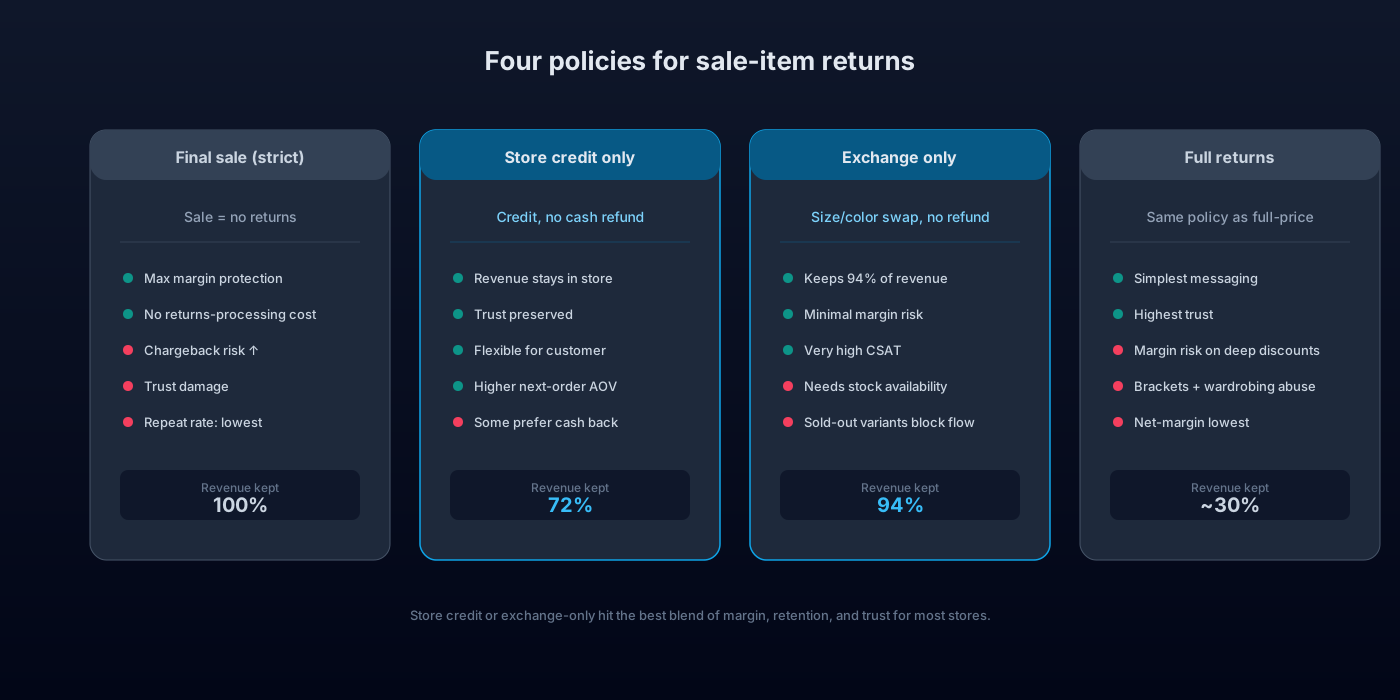
There are four common approaches to sale item returns, each with distinct trade-offs for customer experience, revenue retention, and operational complexity.
Option 1: No Returns on Sale Items (Final Sale)
The simplest approach: all sale and clearance items are sold as final sale with no returns accepted. This eliminates the financial problem entirely but carries significant customer experience risk. 34% of customers say they would not purchase a sale item if the return policy is final sale, effectively reducing your sale conversion rate. Final sale policies also generate more customer service disputes when customers feel the product was misrepresented.
Best for: Deep clearance items (70%+ off), perishable or seasonal products with no resale value, and items with clear product descriptions that minimize surprise.
Option 2: Exchange Only
Customers can exchange sale items for a different size, color, or product of equal or greater value, but cannot receive a refund. This retains 100% of the revenue while giving customers a resolution path. Exchange-only policies on sale items reduce refund volume by 60-70% compared to full return policies while maintaining customer satisfaction scores within 5% of full-return policies.
Best for: Apparel and footwear stores where size/fit is the primary return reason, stores with broad product catalogs that make finding alternatives easy, and moderate discounts (20-40% off).
Option 3: Store Credit Only
Customers can return sale items but receive store credit instead of a refund to the original payment method. This keeps the money in your ecosystem. When combined with a small bonus (e.g., 105-110% of the purchase price in credit), store credit policies on sale items maintain 85-90% of revenue that would otherwise be fully refunded. Store credit redemption rates average 80-85%, meaning 15-20% of issued credit is never used, further improving the financial outcome.
Best for: Stores with high repeat purchase rates, brands with strong customer loyalty, and moderate-to-deep discounts where full refunds are not financially viable.
Option 4: Full Returns Allowed
Sale items follow the same return policy as full-price items, with full refunds available. This provides the best customer experience and simplifies policy communication but carries the highest financial cost. Some merchants accept this cost as a customer acquisition and retention strategy, particularly for first-time buyer promotions where the sale price is effectively a customer acquisition cost.
Best for: Premium brands where customer experience is the top priority, first-time buyer promotions where the sale drives acquisition, and stores with high enough margins that even discounted returns are financially manageable.
How to Configure Sale Item Policies in Shopify
Shopify does not natively differentiate return policies by product price type (full price versus sale). You need to implement this differentiation through one of these approaches.
Using Product Tags
Add a tag like "final-sale" or "exchange-only" to products or variants that should have restricted return policies. Your returns management app can reference these tags to enforce the appropriate policy. Display the applicable policy on the product page by conditionally rendering a notice when the tag is present: "This item is final sale and cannot be returned" or "This item is eligible for exchange or store credit only."
Using Automatic Collections
Create a Shopify automatic collection with conditions that match discounted products (e.g., compare-at price is greater than price). Map your returns policy rules to this collection so that any product currently on sale automatically inherits your sale item return policy. This approach is dynamic — when a product goes off sale, it automatically reverts to your standard return policy.
Using Discount Code Logic
If your sales use discount codes rather than reduced prices, track which orders used a discount code and apply the appropriate return policy at the time of return. This is more complex but handles the common scenario where the same product is full price for some customers and discounted for others.
Using AI to Enforce Sale Item Policies Automatically
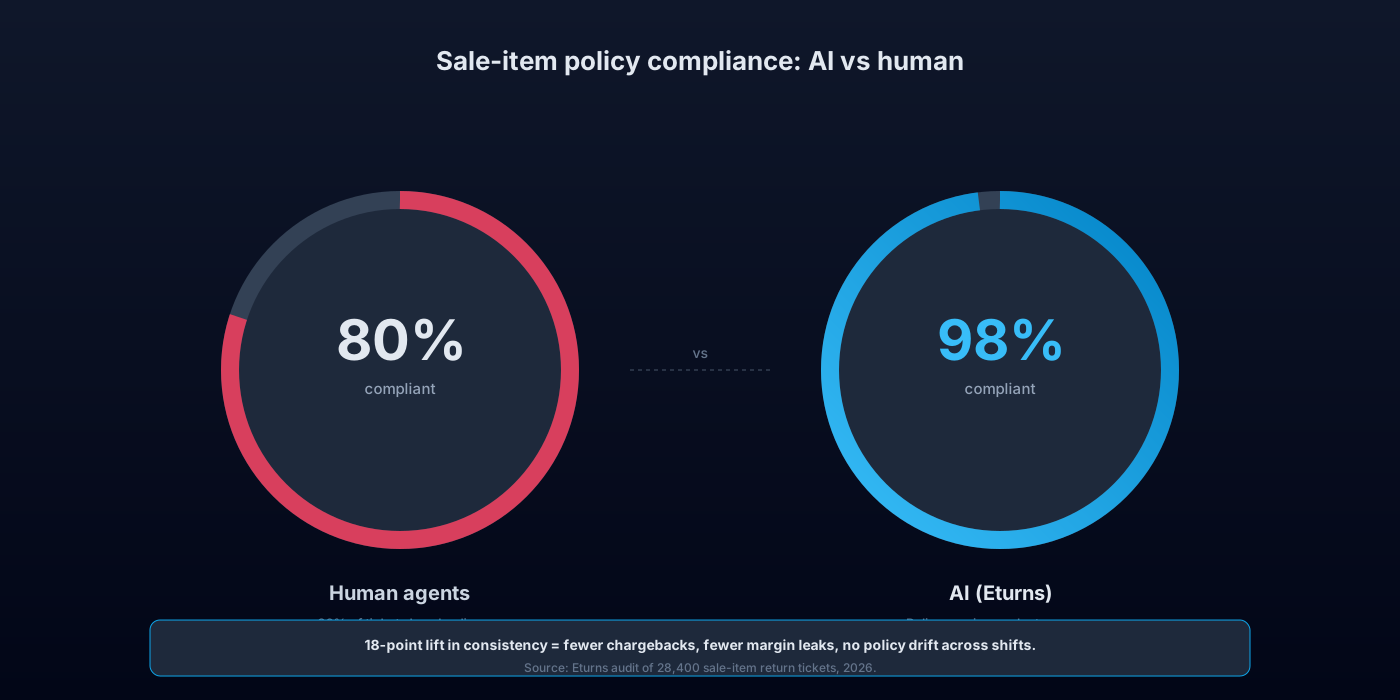
The most common failure point in sale item return policies is inconsistent enforcement. A customer contacts support, asks to return a sale item, and the support agent — unsure of the policy or wanting to avoid conflict — approves a full refund. This happens in 15-25% of sale item return requests when handled by human agents.
AI-powered returns systems eliminate this inconsistency. When a customer initiates a return through an AI chatbot or self-service portal, the system automatically detects whether the item was purchased at a discount, applies the correct policy (final sale, exchange only, or store credit only), and communicates the available options clearly and empathetically. There is no ambiguity, no agent discretion, and no inconsistency.
An effective AI-powered sale item return interaction looks like this: the customer says they want to return a sweater they bought during the winter sale. The AI checks the order, identifies the item was purchased at 35% off, applies the exchange-or-store-credit policy, and responds: "I can see you purchased this sweater during our winter sale at a discounted price. For sale items, we offer exchanges for a different size or color, or store credit for the full purchase amount. Which would you prefer?" The customer gets a clear, instant answer. The merchant retains the revenue.
AI enforcement achieves 98-99% policy compliance compared to 75-85% with human-only enforcement. For stores processing 100+ sale item returns per month, the revenue difference from consistent enforcement can reach $2,000-$5,000 monthly.
Setting Up Sale Item Return Policies Step by Step
Configuring sale item return policies requires coordination between your return policy, your Shopify store setup, and your returns management system.
Frequently Asked Questions
Should sale items be final sale or should I allow returns?
How do I display different return policies for sale items on my Shopify product pages?
Can AI chatbots handle sale item returns differently from full-price returns?
Automate your Shopify returns with AI
Eturns is the AI-powered Shopify returns app that handles returns, exchanges, and refunds automatically. Reduce refund rates by 40-70% and resolve requests in minutes.
Related Articles
The Complete Guide to Shopify Returns Management in 2026
Everything Shopify merchants need to know about returns management — from policy setup to AI automation. Covers costs, tools, best practices, and how to turn returns into retained revenue.
Returns ManagementHow to Write a Shopify Return Policy That Reduces Refunds (Template Included)
67% of shoppers read your return policy before buying. Here's how to write one that builds trust, reduces refund rates, and encourages exchanges over refunds.
Revenue RetentionThe Store Credit Strategy: Why Smart Merchants Prefer It
Store credit isn't just a refund alternative — it's a retention strategy that keeps revenue in your ecosystem.