Eturns Team · February 7, 2026 · Updated April 18, 2026 · 5 min read
What Is After-Sale Support? The Complete Guide for E-commerce
TL;DR
After-sale support is the set of services provided to customers after they complete a purchase, including returns processing, exchanges, refunds, order tracking, warranty claims, and feedback collection. Merchants with strong after-sale support see 25-40% higher customer retention rates.
What Is After-Sale Support?
After-sale support is the full range of services and assistance a business provides to customers following a completed purchase. In e-commerce, this encompasses returns and exchanges, refund processing, order tracking, warranty claims, product troubleshooting, feedback collection, and any other post-purchase interaction between the customer and the brand.
Key numbers: 73% of consumers say post-purchase experience determines repeat purchases (Narvar, 2024). Businesses spend $30-$50 to acquire each customer but less than $2 per customer on post-purchase support. Merchants with strong after-sale support see 25-40% higher customer retention rates. AI-powered after-sale support costs $0.50-$2 per interaction vs $15-$30 for human agents.
After-sale support is the most underinvested and highest-impact area of the e-commerce customer experience. While businesses spend an average of $30-$50 to acquire each customer, they typically allocate less than $2 per customer to post-purchase support infrastructure. This gap is costly: 73% of consumers say their post-purchase experience determines whether they will shop with a brand again, according to a 2024 Narvar consumer survey.
Core Components of After-Sale Support
After-sale support in e-commerce spans six operational areas, each contributing to the overall post-purchase experience.
Returns and Exchanges
The most common after-sale interaction. A returns management system handles return requests, processes exchanges, and manages the logistics of receiving returned inventory. For online stores with return rates of 20-30%, this is the highest-volume post-purchase activity and the one most likely to shape customer perception.
Refund Processing
Issuing monetary refunds to the original payment method, generating store credit, or processing partial refunds for damaged items. Speed matters here — 88% of customers expect refunds to be processed within 5 business days, and delays are the number one driver of post-return complaints.
Order Tracking and Delivery Support
Providing real-time updates on order status, handling delivery exceptions (wrong address, missed delivery, package theft), and managing "where is my order" (WISMO) inquiries. WISMO tickets account for 30-40% of all e-commerce customer service volume.
Warranty and Product Support
Handling warranty claims, providing product usage guidance, troubleshooting defective items, and coordinating repairs or replacements. This is more common in electronics, appliances, and durable goods categories.
Feedback and Review Collection
Soliciting product reviews, processing customer feedback, and acting on quality signals from post-purchase interactions. Returns data is particularly valuable — patterns in return reasons can identify product defects, sizing chart issues, or misleading product photos before they affect thousands of additional customers.
Loyalty and Retention Programs
Post-purchase engagement through loyalty points, personalized recommendations, win-back campaigns for lapsed customers, and VIP programs. These programs transform after-sale support from a reactive cost center into a proactive retention engine.
Why After-Sale Support Matters
The business case for investing in after-sale support is compelling and well-documented across three dimensions.
Customer Retention
Acquiring a new customer costs 5-7x more than retaining an existing one. After-sale support is the primary driver of retention because it is the touchpoint where customers evaluate whether a brand deserves their loyalty. Stores that rate in the top quartile for post-purchase support see 30% higher customer retention rates than bottom-quartile stores.
Brand Reputation
In the age of public reviews and social media, a single poor after-sale experience can reach thousands of potential customers. Conversely, exceptional support generates organic advocacy. The data is clear: customers who have a problem resolved well are 15% more likely to recommend the brand than customers who never had a problem at all. This is the service recovery paradox, and it makes after-sale support a genuine marketing channel.
Repeat Purchases and Revenue
Customers with a positive after-sale experience are 3.5x more likely to make a repeat purchase. For a store with 10,000 annual customers and a $65 average order value, improving after-sale support to convert just 10% more customers into repeat buyers adds $65,000 in annual revenue with zero additional acquisition cost.
Traditional vs. AI-Powered After-Sale Support
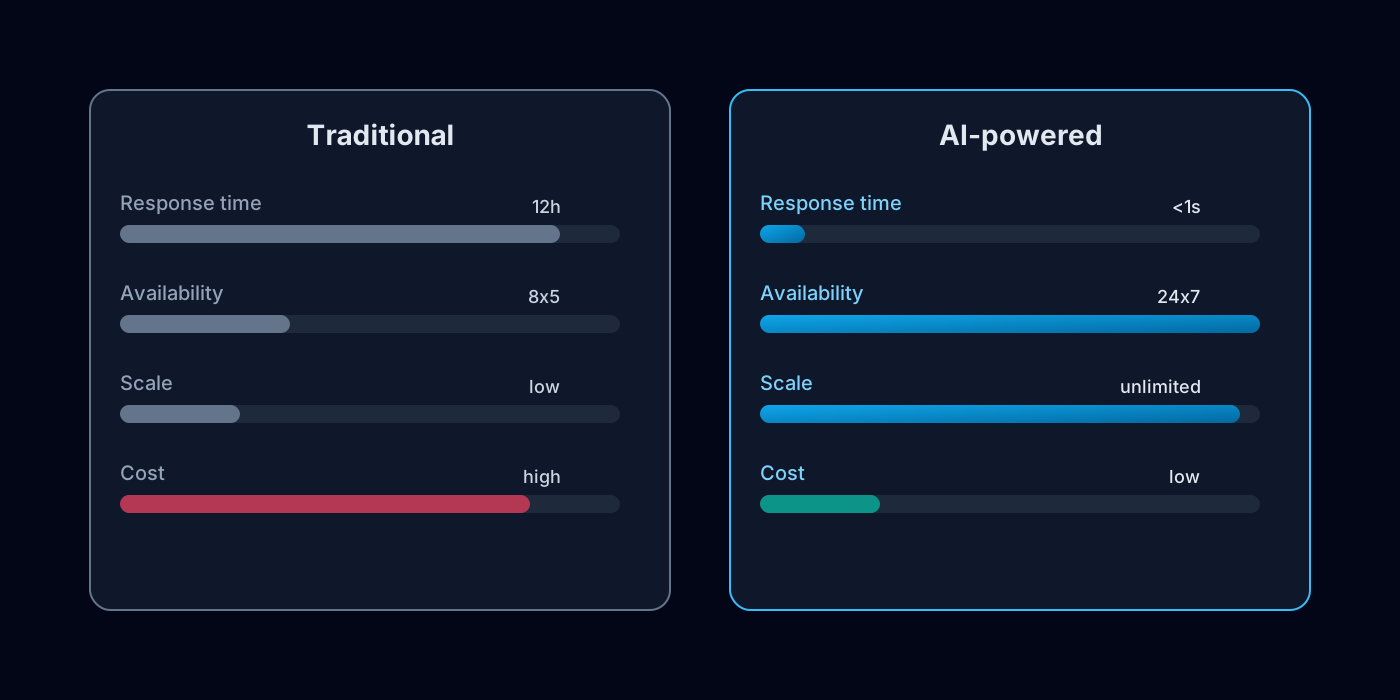
The evolution from traditional to AI-powered after-sale support represents a fundamental shift in how post-purchase interactions are handled.
Traditional After-Sale Support
- Channel: Email tickets and phone calls
- Response time: 4-24 hours for email, variable hold times for phone
- Availability: Business hours only (or expensive 24/7 staffing)
- Scalability: Linear — each additional customer interaction requires proportional staff time
- Consistency: Variable, dependent on individual agent knowledge and mood
- Cost: $5-$15 per customer interaction
AI-Powered After-Sale Support
- Channel: Chat widgets, messaging apps, and email with AI processing
- Response time: Instant (under 3 seconds)
- Availability: 24/7/365 without staffing costs
- Scalability: Near-infinite — AI handles 100 simultaneous conversations as easily as 1
- Consistency: Uniform policy enforcement and tone across every interaction
- Cost: $0.10-$0.50 per customer interaction
AI-powered after-sale support handles the 70-80% of post-purchase inquiries that are routine (return initiation, order tracking, policy questions) while routing complex or emotionally sensitive cases to human agents. This hybrid model delivers the speed and cost efficiency of automation with the empathy and judgment of human support where it matters most.
The most advanced AI after-sale systems go beyond scripted chatbots. They understand natural language, access customer order data in real time, enforce return policies automatically, suggest personalized exchanges, and learn from interaction patterns to improve over time. They function as tireless, knowledgeable support agents rather than glorified FAQ search tools.
Building an Effective After-Sale Support Strategy
Start by mapping every possible post-purchase interaction and assigning each one a priority based on volume and customer impact. Returns, order tracking, and refunds will almost certainly top the list. Automate the high-volume, low-complexity interactions first (order tracking, return initiation, policy inquiries), then progressively add AI-powered handling for more nuanced cases (exchange recommendations, warranty claims). Measure customer satisfaction at each touchpoint and iterate.
The stores that treat after-sale support as a strategic investment rather than an operational afterthought consistently outperform their peers in retention, lifetime value, and organic growth.
Frequently Asked Questions
What is after-sale support in e-commerce?
How does after-sale support affect customer retention?
What is the difference between AI-powered and traditional after-sale support?
How much can after-sale support improve revenue?
Automate your Shopify returns with AI
Eturns is the AI-powered Shopify returns app that handles returns, exchanges, and refunds automatically. Reduce refund rates by 40-70% and resolve requests in minutes.
Related Articles
AI Customer Support for E-commerce: The Complete 2026 Guide
AI customer support is no longer about simple chatbots. In 2026, intelligent agents resolve after-sale requests autonomously. Here's everything you need to know.
GlossaryWhat Is a Returns Management System? Definition, Features & Benefits
A returns management system (RMS) automates the end-to-end process of handling product returns. Learn what it includes, why you need one, and how to choose.
Returns ManagementThe Complete Guide to Shopify Returns Management in 2026
Everything Shopify merchants need to know about returns management — from policy setup to AI automation. Covers costs, tools, best practices, and how to turn returns into retained revenue.