Eturns Team · February 16, 2026 · Updated April 18, 2026 · 5 min read
What Is a Returns Management System? Definition, Features & Benefits

TL;DR
A returns management system (RMS) is software that automates return authorization, policy enforcement, exchange/refund processing, and analytics. It reduces processing costs by 60-80%, improves customer satisfaction, and helps retain revenue through intelligent routing to exchanges and store credit.
What Is a Returns Management System?
A returns management system (RMS) is software that automates and manages the end-to-end process of product returns, exchanges, and refunds for e-commerce and retail businesses. It replaces manual email-based returns handling with structured workflows that enforce return policies, process exchanges and refunds, and provide analytics on return patterns and costs.
Key numbers: RMS software reduces return processing costs by 60-80%. Automated policy enforcement drops error rates from 8-12% to under 1%. Self-service portals reduce support ticket volume by 60-70%. Stores using RMS convert 30-40% of refund requests into exchanges or store credit.
For online merchants, a returns management system sits between the customer-facing return experience and the back-end operations of restocking, refunding, and shipping. For a comprehensive walkthrough of how this applies to Shopify, see our complete Shopify returns management guide. It is the operational layer that determines whether returns drain your business or become a manageable, even profitable, part of your customer lifecycle.
Core Features of a Returns Management System
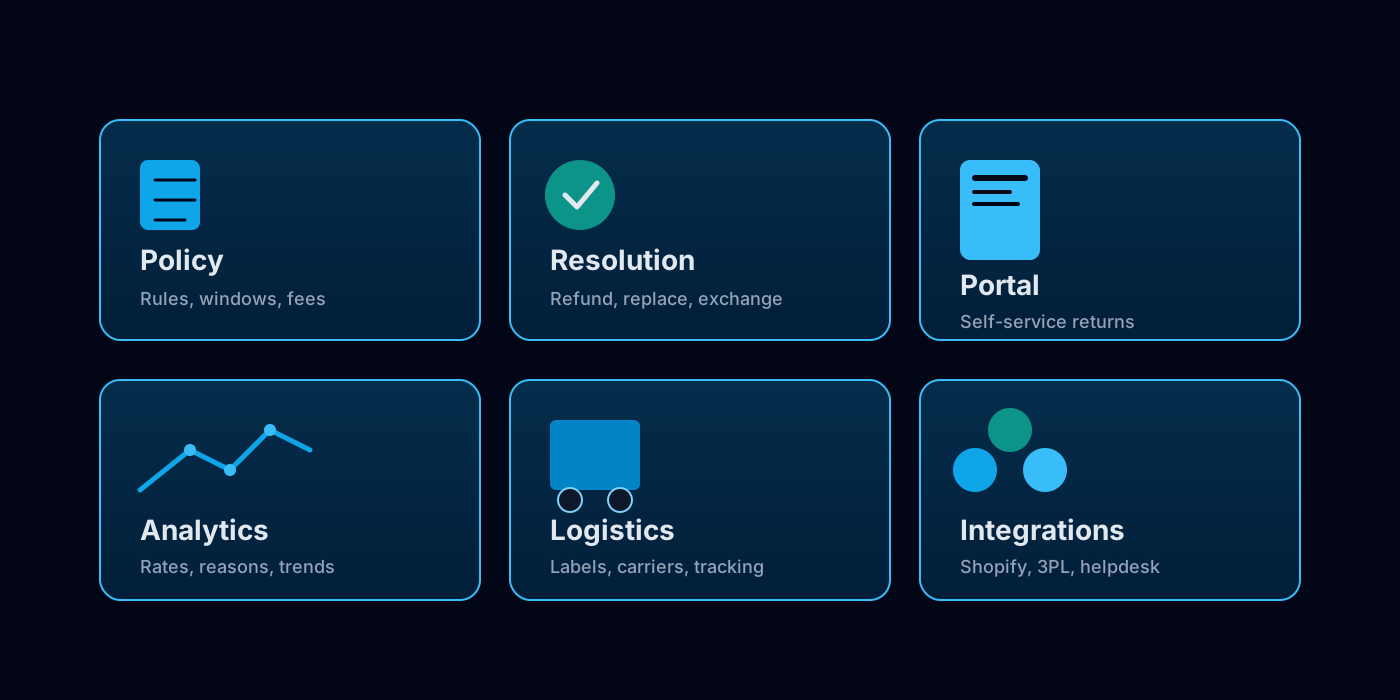
A fully-featured returns management system includes six core capabilities that work together to streamline the return process.
Return Authorization and Policy Enforcement
The system automatically evaluates each return request against your configured policies: return window (e.g., 30 days from delivery), product eligibility (e.g., sale items excluded), condition requirements, and any category-specific rules. This eliminates the need for customer service agents to manually check policies for every request, reducing processing time from an average of 15-20 minutes per return to under 2 minutes.
Exchange and Refund Processing
The system handles the mechanics of issuing refunds to the original payment method, generating store credit, or processing exchanges for alternative products. Advanced systems support instant exchanges (shipping the new item before receiving the return), partial refunds, and store credit with configurable bonus incentives.
Customer-Facing Return Portal or Interface
Most RMS platforms provide a self-service interface where customers can initiate returns without contacting support. This interface collects the return reason, presents exchange or store credit alternatives, generates shipping labels, and provides tracking updates. Self-service portals reduce customer service ticket volume related to returns by 60-80%.
Analytics and Reporting
Data on return rates, return reasons, revenue retained through exchanges, processing costs, and product-level return patterns. This data is critical for identifying problematic products, optimizing return policies, and measuring the financial impact of your returns program. Merchants using RMS analytics report catching product quality issues 40-60% faster than those relying on manual tracking.
Shipping and Logistics Integration
Integration with shipping carriers for generating prepaid return labels, tracking return shipments, and coordinating exchange shipments. Some systems support printer-less returns via QR codes at carrier drop-off locations, which 62% of consumers now prefer over printing labels at home.
Platform and Tool Integrations
Connection to your e-commerce platform (Shopify, WooCommerce, BigCommerce), helpdesk (Zendesk, Gorgias), inventory management, and accounting systems. Integrations ensure that return data flows bidirectionally — inventory counts update when returns are received, and financial records reflect refunds and credits accurately.
Benefits of Using a Returns Management System
Implementing a returns management system delivers measurable benefits across four dimensions.
Time and Labor Savings
Automating return authorization and policy checks reduces per-return processing time by 70-85%. A store processing 300 returns per month that spends 18 minutes per return manually can reclaim roughly 63 hours of staff time monthly — the equivalent of almost a full-time employee.
Cost Reduction
Beyond labor savings, an RMS reduces costs through fewer customer service contacts (60-80% deflection to self-service), lower error rates on refunds, and optimized return shipping through carrier rate comparisons. The average RMS pays for itself within 2-3 months for stores processing more than 50 returns per month.
Revenue Retention
This is the most significant financial benefit. An RMS with exchange-first workflows and store credit incentives typically retains 25-40% of revenue that would otherwise be lost to refunds. For a store with $100,000 in monthly returns, that is $25,000-$40,000 in preserved revenue every month.
Improved Customer Experience
Customers expect a seamless return experience. A 2024 survey found that 84% of online shoppers check a store's return policy before making a purchase, and 73% say the return experience influences whether they shop with a brand again. An RMS delivers the speed, transparency, and ease that customers demand.
Types of Returns Management Systems
Returns management systems fall into three categories based on their approach and technology.
Manual and Spreadsheet-Based
The simplest approach: returns managed via email, spreadsheets, and manual policy checks. This works for stores processing fewer than 20 returns per month but becomes unsustainable beyond that. Error rates are high, customer wait times are long, and there is no analytics capability.
Portal-Based Self-Service
The most common category. These systems provide a branded return portal where customers initiate and track returns independently. The portal enforces policies automatically and supports exchanges and store credit. Examples include Loop Returns, AfterShip Returns, and ReturnGO. Best suited for stores processing 50-5,000+ returns per month.
AI-Powered Conversational
The newest category. These systems use artificial intelligence to handle returns through natural language conversation — typically via a chat widget. The AI understands return reasons, checks policies, suggests exchanges based on inventory and customer history, and processes the return without human intervention. This approach handles the 80% of returns that are straightforward while escalating complex cases to human agents. Eturns is an example of this approach. Best suited for stores wanting to reduce support workload while delivering a personalized return experience.
How to Choose the Right System
The right RMS depends on your return volume, budget, and priorities. For a side-by-side comparison, see our roundup of the best Shopify returns apps. Stores processing fewer than 100 returns per month and prioritizing cost should look at free-tier portal solutions. Stores processing 100-1,000 returns and prioritizing revenue retention should evaluate exchange-first platforms with store credit capabilities. Stores processing any volume and prioritizing customer experience and support reduction should consider AI-powered options that handle returns conversationally.
Regardless of the type, ensure the system integrates natively with your e-commerce platform, supports your specific return policies, and provides the analytics you need to measure return costs and retention rates.
Frequently Asked Questions
What is a returns management system?
How much does a returns management system cost?
Do I need a returns management system for my Shopify store?
What is the difference between a return portal and an AI-powered returns system?
How long does it take to set up a returns management system?
Automate your Shopify returns with AI
Eturns is the AI-powered Shopify returns app that handles returns, exchanges, and refunds automatically. Reduce refund rates by 40-70% and resolve requests in minutes.
Related Articles
The Complete Guide to Shopify Returns Management in 2026
Everything Shopify merchants need to know about returns management — from policy setup to AI automation. Covers costs, tools, best practices, and how to turn returns into retained revenue.
Comparisons5 Best Shopify Returns Apps in 2026 (Compared)
A side-by-side comparison of the top Shopify returns apps — including pricing, features, and which is best for your store size.
GlossaryWhat Is After-Sale Support? The Complete Guide for E-commerce
After-sale support covers everything that happens after a purchase — returns, exchanges, refunds, tracking, and more. Here's what every merchant needs to know.